DESKGRID / INSIGHTS
Digital Transformation: Remove Friction, Not Add Tech
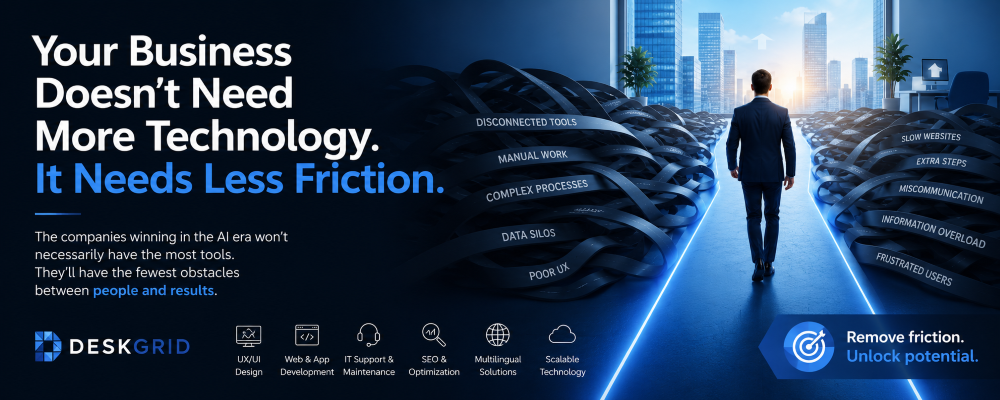
Digital Transformation – The companies winning in the AI era won’t necessarily have the most tools. They’ll have the fewest obstacles between people and results.
There is a strange problem happening inside modern businesses.
We have more technology than ever
More AI
More automation
More dashboards
More SaaS platforms
More communication tools
More data
And somehow…
work can still feel harder than it should.
Employees jump between applications.
Customers abandon confusing websites.
Teams copy information from one system into another.
Someone spends 20 minutes searching for something that should take 20 seconds.
A simple approval requires six clicks, three messages and an email.
Then another tool gets introduced to “solve” the problem.
Sound familiar?
Maybe the biggest digital transformation opportunity isn’t adding more technology.
Maybe it’s removing friction.
Welcome to the Friction Economy
Every business has invisible friction.
You rarely see it on a balance sheet, but you can see its effects everywhere.
A confusing interface is friction.
A slow website is friction.
A customer who can’t find the information they need is experiencing friction.
A team switching between five applications to complete one task is experiencing friction.
Poor mobile design creates friction.
Bad search creates friction.
Disconnected systems create friction.
Unnecessary processes create friction.
Technology is supposed to make things easier
but technology without thoughtful design can simply digitize complexity.
Sometimes it creates entirely new complexity.
The Question Businesses Should Be Asking
For years, organizations asked:
“What technology should we add?”
The better question for 2026 may be:
“What friction can we remove?”
That small change in thinking has enormous consequences.
Instead of starting with software, you start with people.
Where are customers getting confused?
Where are employees wasting time?
Which tasks are repeated unnecessarily?
Which processes require information people already provided?
Which systems don’t communicate?
Where are users abandoning a journey?
What requires five steps that could require two?
Those are not merely UX questions.
They’re business questions.
AI Makes This Even More Important
Artificial intelligence is dramatically changing what’s possible.
AI can summarize information, generate content, analyze data, automate workflows, assist customers and increasingly take action across systems.
But there is a trap.
Businesses can easily use AI to automate bad processes
and a bad process running faster is still a bad process.
Imagine a customer journey containing ten unnecessary steps.
You could introduce AI to make those ten steps faster.
Or you could ask:
Why are there ten steps in the first place?
Sometimes the smartest technology decision is subtraction.
Great UX Is Becoming Business Infrastructure
UX used to be treated primarily as visual design.
Does the interface look modern?
Are the buttons attractive?
Is the branding consistent?
Those things matter
but modern UX goes much deeper.
Good UX reduces the distance between intent and outcome.
A customer wants information.
How quickly can they find it?
An employee wants to complete a task.
How easily can they do it?
A manager wants to understand performance.
Can they see what matters without interpreting twelve dashboards?
A visitor wants to contact your company.
Do they immediately know what to do?
The best digital experiences almost disappear.
Users don’t think:
“What excellent UX architecture.”
They think:
“That was easy.”
And “easy” is an increasingly powerful competitive advantage.
The New Digital Advantage: Invisible Technology
We often celebrate technology people can see.
The AI assistant.
The beautiful website.
The new application.
The impressive dashboard
but some of the best technology is almost invisible.
It’s the integration that automatically moves information between systems.
It’s the infrastructure that keeps a platform responsive.
It’s the security running quietly in the background.
It’s the mobile experience that simply works.
It’s the CMS that lets a team update content without calling a developer.
It’s the automation that eliminates repetitive administration.
It’s the multilingual experience that makes an international customer feel like the product was built for them.
Nobody celebrates these things when they work.
They notice them immediately when they don’t.
Before You Buy Another Tool, Try the 10-Minute Friction Audit
Here’s a simple exercise.
Choose one important journey inside your business.
It could be:
- becoming a customer;
- requesting support;
- purchasing a product;
- on-boarding an employee;
- publishing content;
- generating a report;
- updating customer information.
Now walk through the entire journey.
At every stage ask:
Does this step genuinely need to exist?
Then ask:
Could technology make this simpler or could we eliminate the step entirely?
You may discover something interesting.
Your next breakthrough might not require another platform.
It might require connecting the ones you already have.
The Companies That Win Will Feel Easier
Technology will continue advancing.
AI will become more capable.
Applications will become more intelligent.
Automation will become increasingly accessible.
That means access to technology itself becomes less of a differentiator.
The differentiator becomes how intelligently you use it.
The companies that stand out won’t necessarily be the ones shouting the loudest about AI.
They’ll be the companies where technology quietly makes everything work better.
Their websites will feel effortless.
Their tools will feel intuitive.
Their systems will communicate.
Their customers will find answers faster.
Their teams will spend less time fighting technology and more time doing valuable work.
That is the future of digital experience.
Not technology for technology’s sake.
Technology that gets out of the way.
One Question to Take Back to Your Team
At your next meeting, don’t ask:
“What new technology should we adopt?”
Ask:
“What is the most frustrating digital experience in our business right now?”
Find it
Understand it
Redesign it
Automate what makes sense.
Remove what doesn’t.
Then repeat.
Because sometimes digital transformation doesn’t begin with adding something revolutionary.
It begins by making something unnecessarily difficult finally feel simple.
About DeskGrid
DeskGrid brings design and technology together to create smarter digital experiences from UX/UI and web development to custom applications, IT support, SEO, multilingual solutions and ongoing digital optimization.
Where design meets tech, complexity should become simplicity.
Explore DeskGrid: deskgrid.io